UK joint property ownership for couples: 50/50 or 90/10?


TL;DR:
UK couples can own property as either joint tenants or tenants in common, affecting inheritance and contributions. Proper documentation is essential to protect unequal shares and ensure the correct transfer upon death. Changing ownership structures requires legal steps, including severance, registration, and update of wills.
UK joint property ownership for couples is defined by two legal structures: joint tenancy and tenants in common. These are the only two recognised forms under English and Welsh property law, and the choice between them determines who owns what, who inherits what, and how financial contributions are protected. Couples exploring a 50/50 property split or an unequal arrangement such as 90/10 need to understand both structures before signing anything. Getting this wrong costs money, creates disputes, and can leave a surviving partner legally exposed.
What are joint tenancy and tenants in common, and how do they differ?
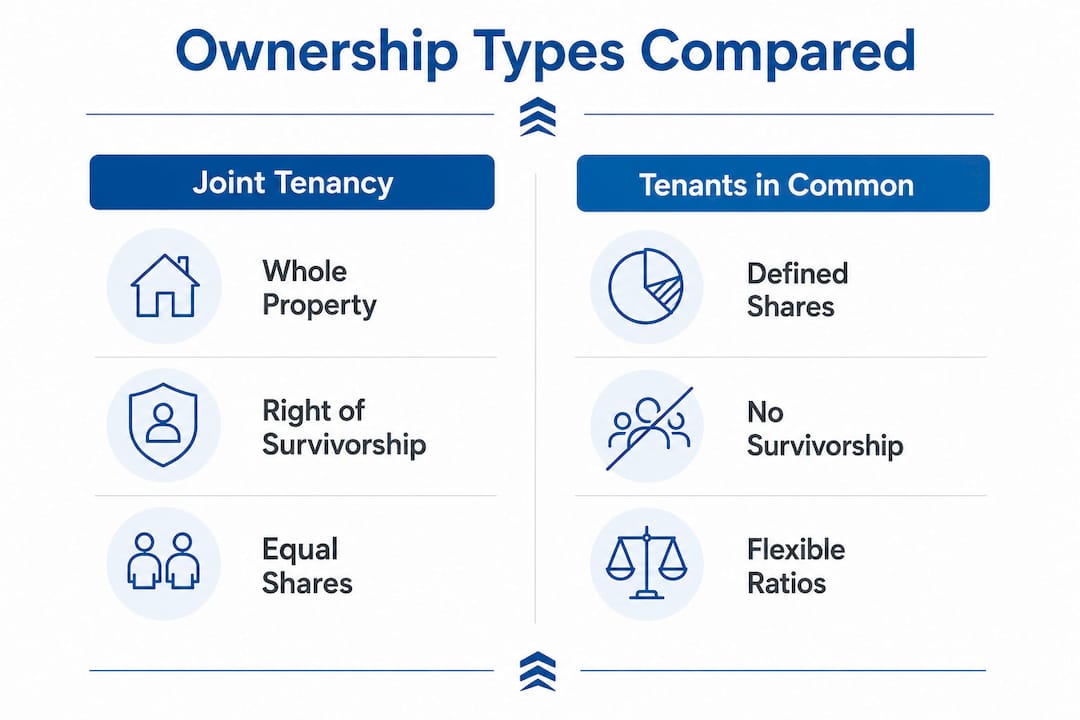
Joint tenancy and tenants in common are the two primary ownership forms for couples buying property together in the UK. They look similar on the surface but work very differently in practice.

In a joint tenancy, both partners own the property as a whole. Neither of you holds a defined percentage. The critical feature is the right of survivorship: if one partner dies, the property passes automatically to the other, regardless of what any will says. This makes joint tenancy simple and is why it remains the default for married couples.
Tenants in common works differently. Each partner holds a defined share, which can be equal or unequal. A 50/50 split means you each own half. A 90/10 split means one partner owns 90% and the other owns 10%. Those shares do not pass automatically on death. They are controlled by the owner’s will, or by intestacy rules if no will exists.
Feature | Joint tenancy | Tenants in common |
Ownership structure | Whole property jointly | Defined individual shares |
Right of survivorship | Yes, automatic | No, controlled by will |
Share ratio | Equal only | Any ratio, e.g. 50/50 or 90/10 |
Typical users | Married couples | Unmarried couples, unequal contributors |
Will overrides ownership | No | Yes |
Pro Tip: If you are unmarried and one partner contributed a larger deposit, tenants in common with a Declaration of Trust is the only structure that legally protects that contribution.
Why might couples choose a 50/50 split versus a 90/10 split?
The right ownership ratio depends on how you and your partner contribute financially, both now and over the life of the mortgage.
A 50/50 split suits couples who contribute equally to the deposit, mortgage payments, and running costs. It is clean, simple, and avoids the need for detailed documentation of contributions. Most married couples with joint finances choose this route.
A 90/10 split, or any unequal ratio, suits situations where contributions are clearly different. Common reasons include:
One partner provides the entire deposit while the other contributes little or nothing upfront.
One partner has a significantly higher income and covers the bulk of monthly mortgage payments.
One partner owns the property as an investment and the other has a minor financial stake.
One partner wants to protect their share from a future creditor or inheritance claim.
Without a Declaration of Trust, courts may assume a 50/50 split even when financial contributions differ significantly. That assumption can lead to disputes or unfair outcomes upon sale or separation. Documenting an unequal arrangement is not optional; it is the only way to make it legally binding.
Mortgage lenders also have a say. Most lenders require both partners to be jointly liable for the full mortgage debt, regardless of ownership ratio. Owning 10% of the property does not mean you are responsible for only 10% of the mortgage. Both partners remain fully liable unless the lender agrees otherwise.
Pro Tip: A Declaration of Trust can specify complex return structures, such as refunding the initial deposit to one partner before any profits are shared. This is particularly useful where one partner funded the deposit entirely.
How does ownership type affect inheritance, wills, and estate planning?
Ownership type has a direct and significant impact on what happens to a property when one partner dies. Getting this wrong is one of the most common and costly mistakes couples make.
In a joint tenancy, the right of survivorship overrides any will. The property passes automatically to the surviving partner. This is straightforward for couples with no children from previous relationships, but it can unintentionally disinherit children or other intended beneficiaries.
In a tenants in common arrangement, each partner’s share is part of their estate. That share passes according to their will. If no will exists, intestacy rules apply, and the outcome may not reflect the couple’s wishes at all.
Key risks to understand:
Unmarried partners in a joint tenancy have no automatic right to each other’s assets beyond the property itself.
Cohabiting couples without wills or declarations risk serious financial exposure if one partner dies or the relationship ends.
Blended families face particular risk: a surviving partner could inherit the full property, leaving children from a previous relationship with nothing.
Tenants in common with unequal shares and no will creates a situation where intestacy rules, not financial logic, determine the outcome.
A will is not a substitute for a Declaration of Trust, and a Declaration of Trust is not a substitute for a will. Couples with unequal ownership shares need both documents working together.
What legal steps can couples take to protect their ownership arrangement?
Couples can change their ownership structure at any time, and the process is more straightforward than most people expect.
Sever the joint tenancy. To move from joint tenancy to tenants in common, one partner serves a written notice of severance on the other. This does not require the other partner’s agreement.
Register a restriction at HM Land Registry. Switching to tenants in common requires registering a Form A restriction on the title. This ensures any future buyer or lender knows the property is held in defined shares.
Draft a Declaration of Trust. HM Land Registry records the legal title, not the beneficial interest. A Declaration of Trust is the document that proves who owns what percentage and on what terms.
Update your wills. Once shares are defined, each partner’s will must reflect how their share should pass on death.
Review on life changes. Relationship changes, additional contributions, or estate planning adjustments all warrant a review of the ownership structure.
Pro Tip: Couples buying property together for the first time should instruct a solicitor to draft a Declaration of Trust at the same time as the conveyancing. Doing it later costs more and creates gaps in protection.
For couples considering property as an investment vehicle, understanding ownership structures for investors is equally relevant, particularly when deciding between personal and company ownership.
Key takeaways
Choosing between joint tenancy and tenants in common is the single most consequential decision couples make when buying property together in the UK, and it must be supported by a Declaration of Trust and a will to be legally effective.
Point | Details |
Two ownership structures | Joint tenancy and tenants in common are the only recognised forms for couples in England and Wales. |
Survivorship overrides wills | In a joint tenancy, the property passes automatically to the surviving partner, regardless of any will. |
Unequal shares need documentation | A 90/10 split is only legally protected through a Declaration of Trust, not through the Land Registry title alone. |
Both documents are required | A Declaration of Trust and a will work together; neither replaces the other for tenants in common. |
Switching is straightforward | Couples can sever a joint tenancy and register a restriction at HM Land Registry without both partners agreeing. |
My view on joint ownership: the default is rarely the right answer
Most couples default to joint tenancy because their solicitor presents it as the simpler option. In many cases, it is. But simplicity is not the same as suitability.
I have seen unmarried couples buy property together under joint tenancy without realising the right of survivorship removes all control over who inherits their share. I have also seen couples with a 90/10 financial split assume the Land Registry title protects them. It does not. Beneficial interest must be documented separately, and most couples only discover this when a dispute arises.
The 50/50 split is not inherently fair, and the 90/10 split is not inherently complicated. What matters is whether the arrangement reflects your actual financial position and whether it is documented correctly. A Declaration of Trust costs a fraction of what a property dispute costs. A will costs even less.
My advice is direct: do not let the conveyancing solicitor decide your ownership structure by default. Have a deliberate conversation with a financial adviser and a solicitor before you exchange contracts. If your contributions are unequal, document them. If you are unmarried, make a will. These are not optional steps for cautious people. They are standard practice for anyone who wants their investment protected.
— Shoaib
How KeystoneFA helps UK couples with joint property ownership
Buying property together is one of the largest financial decisions you and your partner will make. KeystoneFA works with couples across the UK to clarify the financial implications of different ownership structures, from equal 50/50 arrangements to complex unequal splits.
[

](www.keystonefa.co.uk)
KeystoneFA’s advisers help couples understand the tax and financial planning considerations that sit alongside legal ownership decisions, including how ownership ratios affect income tax on rental returns, capital gains tax on sale, and long-term estate planning. For couples considering property as part of a broader investment strategy, KeystoneFA also advises on property investment structures and how to align ownership with financial goals. Speak to the team at KeystoneFA to get advice tailored to your specific circumstances.
FAQ
What is the difference between joint tenancy and tenants in common?
Joint tenancy means both partners own the property as a whole with a right of survivorship. Tenants in common means each partner holds a defined share, such as 50/50 or 90/10, which passes according to their will.
Can couples choose any ownership ratio in tenants in common?
Yes. Tenants in common allows any ratio, including 50/50, 90/10, or any other split that reflects the couple’s financial contributions. The ratio must be documented in a Declaration of Trust to be legally enforceable.
Does HM Land Registry record who owns what percentage?
No. HM Land Registry records the legal title only, not the beneficial interest. A separate Declaration of Trust is required to prove unequal ownership shares.
Can one partner change the ownership structure without the other’s agreement?
Yes, for severance of a joint tenancy. One partner can serve a notice of severance unilaterally. Switching to tenants in common then requires registering a restriction at HM Land Registry.
What happens if an unmarried couple has no will and no Declaration of Trust?
Intestacy rules apply to any tenants in common share, which may not reflect the couple’s wishes. In a joint tenancy, the property passes automatically to the surviving partner, potentially disinheriting other intended beneficiaries.
Recommended