UK CIS explained for contractors: 2026 guide


TL;DR:
Construction contractors in the UK must verify subcontractor status, deduct the correct tax, and submit monthly reports to HMRC to ensure compliance. Failure to adhere to registration, verification, deduction, and reporting rules results in penalties and cash flow issues. Proper management of these processes prevents costly errors and maintains smooth operations under the Construction Industry Scheme.
The Construction Industry Scheme (CIS) requires contractors in the UK to deduct tax at source from payments made to subcontractors, forwarding those deductions to HMRC as advance tax payments. This contractor tax scheme applies across the UK construction sector and affects anyone who pays subcontractors for construction work. Understanding CIS is not optional. HMRC enforces it strictly, and errors carry financial penalties. This guide covers everything you need to know: registration, deduction rates, verification, monthly reporting, and the compliance traps that catch contractors out most often.
What are the obligations of contractors under the CIS?
CIS places the contractor in the role of unpaid tax collector. Accurate verification and invoice review is your best defence against costly errors and penalties. Your obligations begin before you make a single payment.
Here is what you must do as a contractor operating under the scheme:
Register with HMRC as a contractor before making any payments to subcontractors. Businesses that spend over £3 million on construction in any rolling 12-month period are classed as deemed contractors and must register even if construction is not their primary trade.
Verify every subcontractor with HMRC before making the first payment. This confirms their registration status and the correct deduction rate to apply.
Apply the correct deduction rate to the labour element of each payment. The rate depends on the subcontractor’s verified status.
Submit monthly CIS300 returns to HMRC listing all subcontractor payments, materials values, and deductions made during the month.
Pay deductions over to HMRC by the statutory deadline each month.
Issue payment and deduction statements to subcontractors by the 19th of each month, showing gross payments, materials costs, deductions, and net amounts paid.
Non-compliance carries escalating penalties. Late or missing returns attract fixed and daily charges, and failure to deduct correctly can result in HMRC recovering the unpaid tax directly from the contractor.
Pro Tip: Set a recurring calendar reminder for the 19th of each month. That single date covers both your CIS300 submission deadline and your obligation to issue deduction statements to subcontractors.

How do CIS deduction rates work?
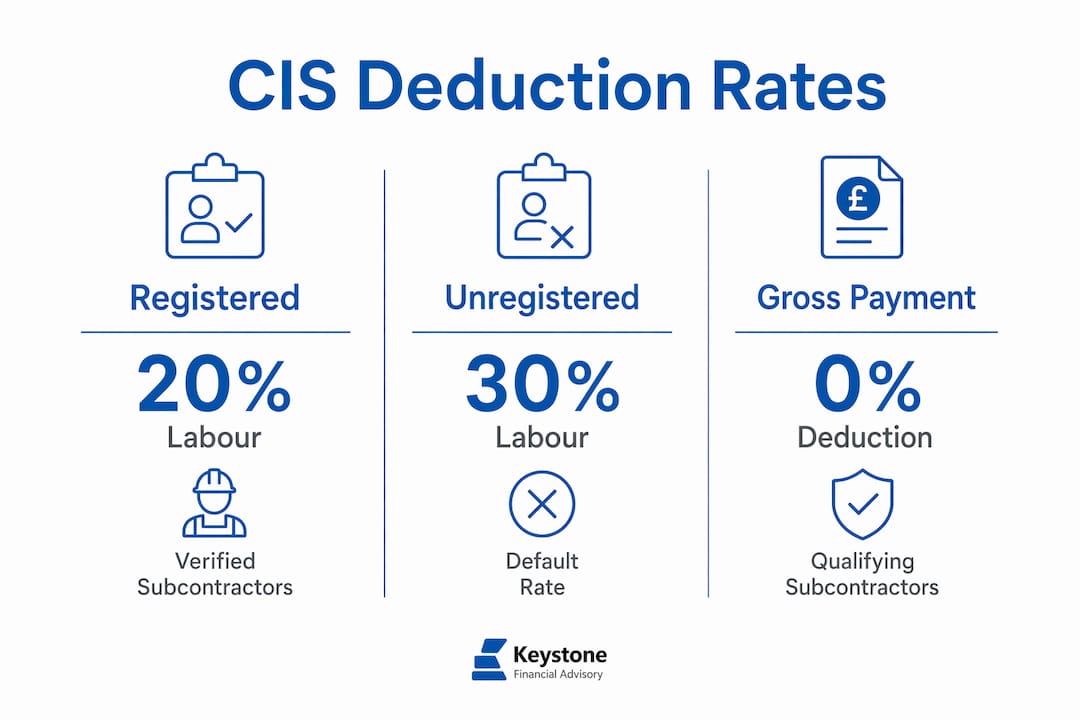
CIS deduction rates in 2026 are 20% for registered subcontractors, 30% for unregistered subcontractors, and 0% for those holding Gross Payment Status (GPS). The rate you apply depends entirely on what HMRC’s verification service tells you.
The three deduction rates at a glance
Subcontractor status | Deduction rate | Applied to |
Registered with HMRC | 20% | Labour only |
Unregistered | 30% | Labour only |
Gross Payment Status | 0% | Not applicable |
The 30% rate is the default when a subcontractor cannot be verified. That is a significant withholding, and it creates cash flow pressure for subcontractors while adding administrative burden for you.
What costs are actually deductible?
CIS deductions apply only to the labour portion of a payment and must exclude materials, plant hire, and fuel. Including materials in the deduction calculation leads to overpayment and creates reconciliation problems that take time and effort to resolve.
The costs you must exclude from the deduction base are:
The cost of materials used in the construction work
Plant hire charges
Fuel costs (except for travelling)
VAT
The costs you must include in the deduction base are:
Labour charges
Travelling expenses paid to the worker
Subsistence payments
Pro Tip: Ask every subcontractor to break down their invoices clearly, separating labour from materials before you process payment. A single line on an invoice reading “construction works: £5,000” gives you nothing to work with and forces you to make a judgement call that HMRC may later challenge.
Gross Payment Status removes CIS deductions altogether. Subcontractors must meet minimum turnover thresholds, pass compliance tests, and maintain a clean HMRC record to qualify. If a subcontractor loses GPS, deductions are reinstated immediately, which can cause real cash flow disruption.
What is the contractor verification process and why is it critical?
Verification is the step that determines which deduction rate you apply. You must verify every new subcontractor with HMRC before making the first payment. Failure to verify means you default to the 30% unregistered rate, which increases the tax withheld unnecessarily and creates friction with subcontractors.
The verification process works as follows:
Contact HMRC via the online portal or by telephone before the first payment
Provide the subcontractor’s name, Unique Taxpayer Reference (UTR), and National Insurance number if they are an individual
HMRC confirms the subcontractor’s status and the applicable deduction rate
Record the verification reference number and retain it in your records
Recording and retaining verification references is not optional. HMRC can request these during a compliance check, and missing records leave you exposed. Good record-keeping practices are the foundation of passing any HMRC audit without issue.
You do not need to re-verify a subcontractor every month. Once verified, the status stands until HMRC notifies you of a change. That said, it is worth checking periodically, particularly for subcontractors you use regularly, as their status can change if they fall out of compliance with HMRC.
How to manage CIS monthly reporting and payment submission
Monthly reporting under CIS follows a fixed cycle. Monthly CIS300 returns must be submitted by the 19th of each month, covering all payments made to subcontractors in the previous tax month. The same deadline applies to paying the deductions over to HMRC.
Follow these steps each month to stay compliant:
Compile all subcontractor payments made during the tax month, separating labour and materials values for each.
Calculate the deduction for each subcontractor based on their verified status and the labour element of their payment.
Complete and submit the CIS300 return via HMRC’s online service by the 19th of the following month.
Pay the total deductions to HMRC by the same 19th deadline. Late payment attracts interest charges.
Issue payment and deduction statements to each subcontractor by the 19th, giving them the figures they need for their own tax returns.
Submit a nil return if you made no payments to subcontractors that month. HMRC still requires a return, and failing to submit one triggers a penalty.
Penalties for late or missing returns escalate the longer the delay continues. A single missed return can result in a fixed penalty, with additional daily charges accumulating if the return remains outstanding. The penalty structure is designed to encourage prompt filing, not to give contractors a grace period.
Key takeaways
The Construction Industry Scheme requires contractors to deduct tax at source, verify subcontractor status before first payment, and submit monthly CIS300 returns by the 19th of each month to stay compliant with HMRC.
Point | Details |
Register before paying | All contractors must register with HMRC before making any payment to a subcontractor. |
Verify every subcontractor | Use HMRC’s verification service before the first payment to confirm the correct deduction rate. |
Apply the right rate | Rates are 20% (registered), 30% (unregistered), and 0% (Gross Payment Status), applied to labour only. |
Exclude materials from deductions | Deductions apply to labour costs only. Materials, plant hire, and fuel must be excluded. |
File and pay by the 19th | Submit CIS300 returns and pay deductions to HMRC by the 19th of each month without exception. |
CIS in practice: what I have seen go wrong
The biggest compliance failure I see is not missed deadlines. It is contractors deducting from the full invoice value instead of the labour element alone. Labour and materials must be clearly separated on invoices to prevent over-withholding. HMRC audits pick this up quickly, and the contractor carries the liability.
The second most common issue is skipping verification because a subcontractor seems trustworthy or has worked with the business before. Trust has nothing to do with it. Verification via HMRC is a legal requirement, not a courtesy check. Defaulting to 30% because you did not verify costs the subcontractor money and creates disputes that damage working relationships.
What actually works is treating CIS as a monthly accounting task with a fixed process, not something you deal with reactively. Contractors who build verification and invoice review into their payment workflow rarely have compliance problems. Those who treat it as an afterthought end up in HMRC correspondence they could have avoided entirely.
— Shoaib
How KeystoneFA supports contractors with CIS compliance
CIS administration takes time and precision. Errors cost money, and the monthly cycle leaves no room for guesswork.
[

](www.keystonefa.co.uk)
KeystoneFA works with contractors across the UK to manage CIS registration, subcontractor verification, monthly CIS300 returns, and payment statements. The team handles the detail so you can focus on running your business. Whether you are new to the scheme or dealing with a compliance issue, KeystoneFA’s accounting services give you expert support from professionals who understand the construction sector. Penalties are avoidable with the right processes in place, and that is exactly what KeystoneFA helps you build.
FAQ
What is CIS and who does it apply to?
CIS is a UK tax deduction scheme requiring contractors to withhold tax from payments to subcontractors in the construction industry and pay those deductions to HMRC. It applies to any business that pays others to carry out construction work.
What deduction rate applies if I cannot verify a subcontractor?
If HMRC cannot verify a subcontractor, you must apply the 30% unregistered rate to the labour element of their payment. Always verify before the first payment to avoid this.
Do CIS deductions apply to materials costs?
No. CIS deductions apply only to labour costs and must exclude materials, plant hire, and fuel. Over-deducting on materials is a common compliance error.
What is Gross Payment Status and how does a subcontractor qualify?
Gross Payment Status means no CIS deductions are made from the subcontractor’s payments. Subcontractors must meet turnover thresholds, pass compliance tests, and maintain a clean HMRC record to qualify and retain it.
What happens if I miss the monthly CIS300 deadline?
Missing the CIS300 deadline triggers a fixed penalty, with escalating daily charges the longer the return remains outstanding. Nil returns are also required when no subcontractor payments were made that month.
Recommended