Dividend tax rise April 2026: salary vs dividends strategy

TL;DR:
From April 6, 2026, the UK increased dividend tax rates, making dividends less tax-efficient for many directors.
Strategic pay-mix planning, including pension contributions and timing dividends, is essential to mitigate the impact.
From 6 April 2026, the basic dividend tax rate rose from 8.75% to 10.75% and the higher rate from 33.75% to 35.75%, legislated in the Finance Act 2026. That 2 percentage-point rise directly undercuts the classic low-salary/high-dividend playbook many limited company directors have relied on for years. The advantage of extracting profits as dividends rather than salary has narrowed, but it has not disappeared. What has changed is that the maths now varies more sharply by band, and blanket strategies are riskier than they were.
Who is most affected:
Basic-rate directors drawing meaningful dividends above the £500 allowance: paying more tax per £10,000 of dividends
Higher-rate directors on large dividend draws: facing an increased tax bill on sizeable dividend tranches
Who is not materially affected: Directors whose dividends fall entirely within the additional-rate band, where the 39.35% rate is unchanged.
TL;DR action: Re-run your pay-mix model now. Consider employer pension contributions, check distributable reserves, and review the timing of any dividends relative to 6 April 2026.
Table of Contents
What exactly changed on 6 April 2026?
The Finance Act 2026 amended the Income Tax Act 2007, substituting the previous dividend rates with new figures effective for 2026/27 and subsequent tax years. The table below shows the before-and-after position.
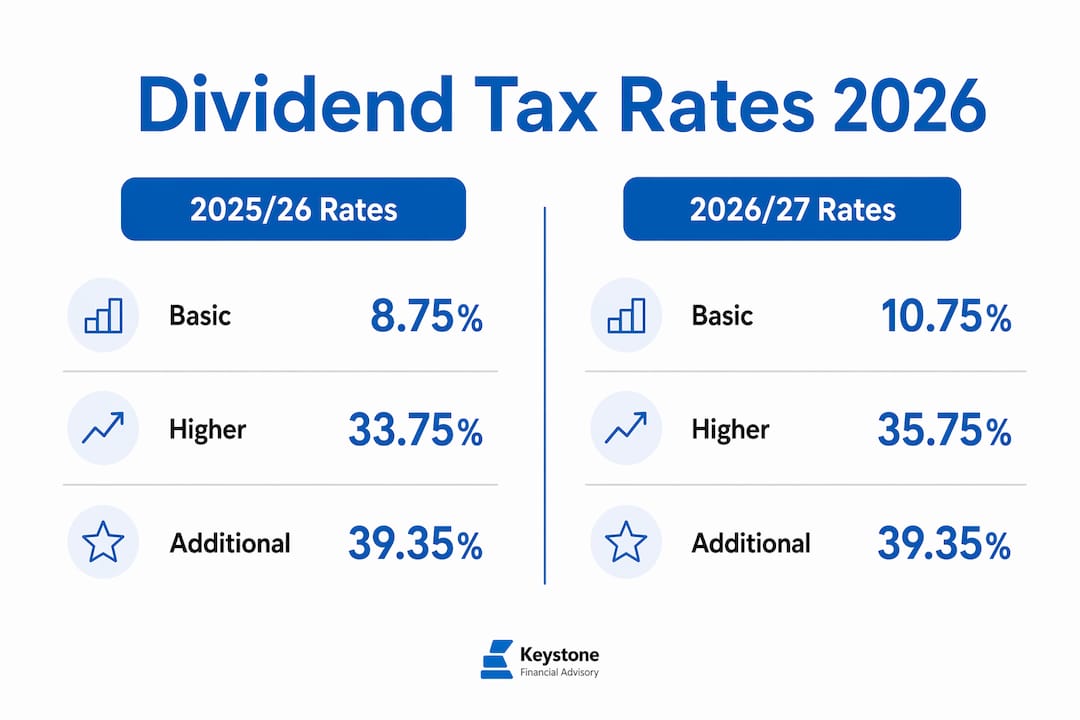
Rate band | 2025/26 rate | 2026/27 rate | Change |
Basic (ordinary) rate | 8.75% | 10.75% | +2pp |
Higher (upper) rate | 33.75% | 35.75% | +2pp |
Additional rate | 39.35% | 39.35% | Unchanged |
The dividend allowance remains at £500 for 2026/27, and the personal allowance stays at £12,570. Band thresholds are also unchanged. This is a rate-only change: the structure of how dividends are taxed, the ordering rules, and the allowances all remain the same.
The first Self Assessment filing affected by these rates will be due by 31 January 2028 (for the 2026/27 tax year), but directors who pay tax on account will feel the cash impact sooner. The GOV.UK guidance confirms the new rates and the calculation method.
The government’s stated rationale: raising dividend tax rates to narrow the gap between tax on employment income and tax on income from assets, since dividend recipients do not pay National Insurance.
How dividends and salary are actually taxed
Understanding the mechanics is what separates a well-modelled pay-mix decision from a guess.

The top-slice rule. GOV.UK confirms that dividends are treated as the top slice of income, sitting above salary, pension income, and savings income in the ordering of tax bands. That matters because a director taking a low salary of, say, £12,570 (equal to the personal allowance) and then drawing dividends will find those dividends consuming the basic-rate band first, then the higher-rate band. A salary increase pushes dividends further up the stack.
Salary versus dividends: the company-level picture. Salary is a deductible business expense, so it reduces the company’s taxable profit and therefore its corporation tax (currently 25% for profits above £50,000, or 19% for small profits under £50,000). Dividends are paid from post-tax profits and carry no corporation tax deduction. Employer National Insurance Contributions (NICs) at 15% apply to salary above the secondary threshold, adding a real cost to the company. Dividends carry no NICs at all, for either the company or the director.
Key thresholds for 2026/27:
Personal allowance: £12,570
Basic-rate band: £12,571–£50,270
Higher-rate band: £50,271–£125,140
Additional-rate threshold: above £125,140
Dividend allowance: £500 (sits within the relevant band, not on top of it)
Employee NICs: 8% on earnings £12,570–£50,270; 2% above
Employer NICs: 15% on salary above £5,000 secondary threshold
The extraction sequence in practice: salary is processed through PAYE and NICs first, then other income, then dividends land on top as the final slice. A director drawing £50,000 total (say, £12,570 salary plus £37,430 dividends) will have the first £500 of dividends covered by the allowance, and the remaining £36,930 taxed at the basic dividend rate of 10.75%.
Worked examples: how the 2p rise changes the numbers
Assumptions used throughout:
Corporation tax rate: 25% (main rate, profits above £50,000)
Director salary: £12,570 (equal to personal allowance, no employee NICs triggered below this)
Dividend allowance: £500 (applied before dividend tax)
No pension contributions modelled unless stated
Spouse income splitting excluded
All figures rounded to the nearest pound
Scenario A: basic-rate director drawing £10,000 dividends
2025/26 | 2026/27 | Difference | |
Dividends drawn | £10,000 | £10,000 | — |
Covered by allowance | £500 | £500 | — |
Dividend tax rate | 8.75% | 10.75% | +2pp |
Scenario B: higher-rate director drawing £80,000 total (£12,570 salary + £67,430 dividends)
Of the £67,430 dividends, £500 is covered by the allowance. The remaining £66,930 splits across the basic-rate band (£37,700 available after salary) and the higher-rate band (£29,230).
Slice | Rate 2025/26 | Tax 2025/26 | Rate 2026/27 | Tax 2026/27 |
Basic-rate slice: £37,700 | 8.75% | — | 10.75% | — |
Higher-rate slice: £29,230 | 33.75% | — | 35.75% | — |
Combined extraction rate check. Using the combined-rate methodology: at 25% corporation tax, 75p of every £1 of profit is available for distribution. At the basic dividend rate, the combined rate is 25% + (75% × 10.75%) = 33.06% in 2026/27, up from 31.56% in 2025/26. At the higher rate: 25% + (75% × 35.75%) = 51.81%, up from 50.31%.
For comparison, a director taking the same income entirely as salary would face income tax plus employee and employer NICs, with the employer NIC cost reducing the profit pool. The dividend route still tends to be more tax-efficient at the basic band, but the margin has shrunk by roughly 1.5 percentage points on a combined basis.
Edge cases worth noting:
Directors whose total income touches the £100,000–£125,140 band lose personal allowance at 50p per £1, making the effective marginal rate on dividends in that range considerably higher
The additional-rate band (above £125,140) is unaffected by the 2026 change; the 39.35% rate holds
Practical steps to take now
The rate change is enacted. The question is what you do about it.
Do now (before or immediately after 6 April 2026):
Re-model your pay-mix using your actual profit figures, salary level, and expected dividends. Generic calculators give a starting point; your specific corporation tax position and band exposure change the answer materially.
Review distributable reserves before declaring any dividend. A dividend paid without sufficient retained profits is unlawful, regardless of tax planning intent.
Check whether any dividends can be timed before 6 April 2026 if you are in the current tax year planning window. Dividends declared and paid before that date are taxed at the old rates.
Review year-end tax planning actions: pension contributions, salary adjustments, and reserves checks all interact with dividend timing.
Plan for later (medium-term strategic shifts):
Employer pension contributions are deductible against corporation tax and carry no NICs. They move extraction into a tax-advantaged wrapper and often outperform a change in salary level as a mitigation strategy.
Consider whether a modest salary increase (to the NIC secondary threshold or above) changes the combined rate favourably once employer NIC and corporation tax deductibility are factored in.
Share option schemes (EMI in particular) may become relatively more attractive given the widened cost of dividend extraction.
Red flags to avoid:
Declaring dividends without checking distributable reserves — this is a common mistake that creates legal risk, not just a tax problem
Double-counting the dividend allowance when both spouses are shareholders
Assuming the old pay-mix is still optimal without re-running the numbers
Pro Tip: Employer pension contributions reduce the company’s taxable profit before corporation tax is calculated, meaning the tax saving compounds: less CT paid, and the pension pot grows in a NICs-free, income-tax-deferred wrapper. For a higher-rate director, this can outperform an equivalent dividend draw by a meaningful margin.

How we modelled these examples
The calculations above follow a consistent methodology so you can reproduce them or hand them to your accountant.
Core assumptions:
Corporation tax at 25% (main rate); adjust to 19% if your profits are below £50,000
Director salary set at £12,570 (personal allowance level) to eliminate income tax on salary and keep employee NICs at zero; employer NICs are also zero at this salary level since it is below the £5,000 secondary threshold after the 2025 Budget change
Dividend allowance of £500 applied before dividend tax in the relevant band
No pension contributions unless explicitly stated
Dividends assumed to be the only income above salary (no rental, savings, or other sources)
Combined-rate formula: CT rate + (1 − CT rate) × dividend tax rate
The combined-rate formula explained. If the company earns £100 of profit, it pays 25% CT, leaving £75. That £75 is distributed as a dividend. The director then pays dividend tax on £75 at the applicable rate. The total tax on the original £100 is: £25 CT + (£75 × dividend rate). Divide by £100 to get the combined percentage.
Limitation: these are illustrative models. Your actual position depends on your corporation tax rate, total income from all sources, any pension contributions, and the timing of distributions. Small changes in any of these inputs can shift the optimal pay-mix.
If you want to re-run the numbers for your own figures, the formula above is the starting point. KeystoneFA offers bespoke pay-mix modelling sessions where an adviser works through your specific profit level, salary, and extraction preferences.
How multiple income sources and spouse shareholdings affect the picture
A director with rental income, savings interest, or freelance earnings alongside company dividends will find those other income sources consuming the lower tax bands first, pushing dividends higher up the stack. If rental income already fills the basic-rate band, every pound of dividend is taxed at the higher dividend rate of 35.75%, not 10.75%. That changes the combined-rate calculation significantly and may make pension contributions or retained profits the better route.
Spouse or civil partner shareholdings remain a legitimate planning tool where the spouse genuinely holds shares and receives dividends in their own right. If a spouse has unused basic-rate band, their dividends are taxed at 10.75% rather than the director’s 35.75%, which still represents a material saving even after the rate rise. The key condition is that the share structure must reflect genuine economic ownership; HMRC’s settlements legislation (the Arctic Systems case remains the reference point) applies where arrangements lack commercial substance.
For directors with investment portfolios held outside ISAs, the same dividend rate rise applies to those holdings. Moving investments into a Stocks and Shares ISA shelters future dividends entirely, and dividends within a SIPP or registered pension scheme are also tax-free.
Extraction routes beyond salary and dividends
The rate rise makes it worth revisiting the full menu of extraction options, not just the salary-versus-dividends binary.
Director’s loan accounts allow a director to draw money from the company as a loan rather than salary or dividend. Loans up to £10,000 can be interest-free without triggering a benefit-in-kind charge. Above that, a beneficial loan rate applies. Loans must be repaid within nine months of the company’s accounting year-end, or the company faces a 33.75% Section 455 tax charge on the outstanding balance. Overdrawn director’s loan accounts carry real risk if not managed carefully, and they are not a substitute for proper pay-mix planning.
Benefits in kind such as a company car, private medical insurance, or phone can substitute cash extraction and may be more tax-efficient depending on the benefit’s P11D value and the director’s marginal rate. A company car versus mileage claim comparison, for instance, can yield meaningful savings for high-mileage directors. Benefits do not reduce the dividend tax bill directly, but they reduce the cash the director needs to extract, which lowers the total dividend draw and therefore the tax exposure.
Employer pension contributions sit in a category of their own. They are deductible against corporation tax, carry no NICs, and do not count as income for the director in the year of contribution. For a higher-rate director, the combined saving from reduced CT and avoided dividend tax can be substantial.
Long-term investment decisions under the new tax cost
The 2pp rise has a subtler effect on business investment decisions that directors often overlook. When the cost of extracting profits rises, retaining earnings in the company becomes relatively more attractive. Retained profits can fund capital expenditure, R&D, or working capital without triggering any personal tax at the point of retention. The tax cost only crystallises when profits are eventually extracted.
This changes the calculus for directors deciding whether to leave profits in the company or distribute them. A director who previously extracted everything annually may now find that retaining a portion and investing it in the business (or in company-held assets) defers the tax cost and potentially reduces it if their personal income falls in a later year.
The flip side is that retained profits are not accessible without triggering tax on extraction, and a company with large retained earnings can face complications on a future sale or wind-up. The optimal retention level depends on the director’s personal income needs, the company’s investment plans, and the expected future tax environment.
How bonuses and share options compare
A bonus is simply salary paid in a lump sum. It is subject to income tax and NICs in exactly the same way as regular salary, which means it does not benefit from the dividend tax rates. For a higher-rate director, a bonus is taxed at 40% income tax plus employee NICs at 2% (above £50,270), and the company pays employer NICs at 15%. That makes a bonus considerably more expensive than a dividend at the higher rate, even after the 2pp rise.
Enterprise Management Incentive (EMI) share options are worth serious consideration for owner-managed businesses that qualify. Gains on EMI options are taxed as capital gains rather than income, currently at 18% or 24% depending on the director’s total gains and income. That is materially lower than the 35.75% higher dividend rate, and the company gets a corporation tax deduction on the option gain. EMI schemes require HMRC valuation approval and a qualifying company structure, but for eligible businesses they represent one of the most tax-efficient long-term remuneration tools available.
Growth share schemes and other equity arrangements can also shift value out of the income tax regime and into capital gains, though they require careful legal and tax structuring. These are medium-term tools, not a quick fix for the April 2026 rate change.
Talking to your accountant and stakeholders about the change
The most common mistake directors make after a tax change is assuming their accountant has already factored it in. They may have, but unless you have had an explicit conversation about your pay-mix for 2026/27, do not assume the old structure is still optimal.
When you speak to your accountant, bring three things: your expected profit for the year, your current salary level, and your planned dividend draw. Ask them to model the combined extraction rate under the new rates and compare it to an employer pension contribution scenario. That conversation typically takes less than an hour and can identify savings that dwarf the cost of the meeting.
For directors with external shareholders or investor shareholders, the rate change affects all dividend recipients equally. If your company has a dividend policy, it is worth communicating to shareholders that the personal tax cost of dividends has risen, particularly for basic- and higher-rate taxpayers. This is relevant for family shareholders who may not be aware of the change.
If you have a board or management team, a short briefing note explaining the rate change, its effect on take-home pay, and the company’s response (whether that is a salary adjustment, a pension contribution, or a change in dividend timing) demonstrates good governance and avoids surprises at year-end.
Key takeaways
The April 2026 dividend tax rise narrows the extraction advantage for basic- and higher-rate directors, but employer pension contributions and careful pay-mix modelling can recover much of the lost ground.
Point | Details |
Rate changes confirmed | Basic dividend rate rose to 10.75%; higher rate to 35.75% from 6 April 2026. Additional rate unchanged at 39.35%. |
Cash cost per director | A basic-rate director pays more per £10,000 of dividends; a higher-rate director faces a larger increase on a significant draw. |
Combined extraction rate | At 25% CT, the basic-band combined rate is now 33.06% and the higher-band rate is 51.81%. |
Immediate action | Re-model your pay-mix now; check distributable reserves and consider timing dividends before 6 April where possible. |
KeystoneFA next step | KeystoneFA offers bespoke pay-mix modelling to identify the optimal salary, dividend, and pension mix for your specific position. |
The change matters more than most directors realise
The conventional response to a dividend tax rise is to shrug and say the dividend route is still better than salary. That is often true at the basic band, but it misses the more important question: better than what, exactly?
The comparison should not be salary versus dividends in isolation. It should be the full extraction mix, including employer pension contributions, benefit-in-kind substitution, and retained profit strategy, modelled against your actual profit level and personal income. When you run that comparison properly, the 2pp rise sometimes tips the balance towards pensions in a way that saves more than the rate change costs.
What I see repeatedly is directors who set their salary and dividend levels once, often at incorporation, and never revisit them. A rate change like this is the forcing function to do that work. The directors who come out ahead are not the ones who found a clever workaround; they are the ones who modelled their position honestly and made a deliberate choice.
The additional-rate band being unchanged is also worth noting. For very high earners, the top slice of dividends costs the same as before. The pressure falls squarely on the basic- and higher-rate bands, which is where the majority of owner-managed business directors sit. That is not a coincidence; it is where the revenue is.
How KeystoneFA can help you model the right pay-mix
The rate change has made bespoke modelling more valuable than it was twelve months ago. A generic salary-versus-dividends calculator will give you a number, but it will not account for your corporation tax rate, your other income sources, your pension position, or the timing of your distributions.
[

](www.keystonefa.co.uk)
KeystoneFA works with limited company directors and founders to build pay-mix models that reflect their actual numbers, not a template. The team combines proactive tax planning with day-to-day accounting support, so the modelling feeds directly into your payroll, dividend declarations, and year-end filings. Services include director remuneration planning, employer pension contribution structuring, and Companies House and HMRC compliance. Many of the team have worked with top firms in the UK and the Middle East, bringing a depth of experience that smaller owner-managed businesses rarely access elsewhere.
To get a bespoke pay-mix review for 2026/27, book a consultation with KeystoneFA and bring your latest profit figures. The conversation will cover your current extraction structure, the impact of the new rates on your specific position, and the options available to you before your next year-end.
Useful sources
GOV.UK: Changes to tax rates for property, savings and dividend income — the government’s official policy paper explaining the rationale and scope of the April 2026 dividend rate changes
GOV.UK: Tax on dividends — authoritative guidance on how dividend tax is calculated, including the top-slice rule and 2026/27 rates
Finance Act 2026, section 4 — legislation.gov.uk — the primary legislative source confirming the substitution of rates in ITA 2007
PwC UK tax summaries: taxes on personal income — practitioner-level commentary on UK personal tax rates including dividend and NIC interactions
UK Tax Tools: dividend tax rise April 2026 — worked combined-rate calculations and illustrative extra-cost figures used in the examples above
KeystoneFA: how much can I take out of my limited company tax efficiently? — practical guidance on tax-efficient extraction for directors
FAQ
How will the dividend tax change from April 2026?
The basic dividend rate rose from 8.75% to 10.75% and the higher rate from 33.75% to 35.75%, effective 6 April 2026. The additional rate remains unchanged at 39.35%.
Is it still better to take dividends rather than salary after the rise?
For most basic-rate directors, dividends remain more tax-efficient than salary when the combined corporation tax and dividend tax cost is compared to PAYE plus NICs. The combined basic-band extraction rate is now 33.06%, which is still below the equivalent PAYE burden for many directors, but the margin is narrower than before.
Are dividends taxed differently from salary?
Yes. Salary is subject to income tax and National Insurance Contributions (both employee and employer); dividends are paid from post-tax profits and taxed at the lower dividend rates, with no NICs on either side. Dividends also sit as the top slice of income under the ordering rules.
How is the tax on dividends changing, and when does it first affect my Self Assessment?
The Finance Act 2026 enacted the changes for the 2026/27 tax year. The first Self Assessment return affected is for 2026/27, due by 31 January 2028, though directors who make payments on account will feel the cash impact earlier.
What is the most effective way to reduce the impact of the higher dividend rates?
Employer pension contributions are one of the most effective responses: they reduce the company’s taxable profit, carry no NICs, and move extraction into a tax-advantaged wrapper. KeystoneFA can model whether a pension contribution, a salary adjustment, or a change in dividend timing produces the best outcome for your specific position.
This article is general information, not professional tax or financial advice. Tax rules depend on your individual circumstances and can change. Confirm the current position with HMRC or a qualified tax adviser before making decisions about your remuneration structure.
Recommended